
The agencies that win the most awards are not necessarily the ones doing the most creative work. They are the ones who treat awards as a strategic discipline rather than an afterthought. They know which programs are worth entering before the season opens. They understand what judges are rewarding in specific categories. They have a process for gathering evidence before deadlines, not scrambling for results data the night before submissions close. They use data to decide, not instinct alone.
That gap between reactive award entry and strategic awards intelligence is what this playbook addresses. It covers the five dimensions of a structured awards intelligence practice and how to apply each one across a full award year. The tools and data sources referenced throughout are available through the Awardy Awards Directory, the Awards Calendar, and the broader Awardy platform.
What awards intelligence actually means
Awards intelligence is the structured use of award program data, winner records, category analysis, and competitive information to make better decisions about which programs to enter, which categories to target, how to write entries, and how to allocate budget across a submission programme.
It is not about winning at all costs or entering everything. It is about understanding the landscape well enough to make informed decisions about where your work is genuinely competitive, where entry fees are justified by realistic win probability, and where your creative output has the strongest fit with what specific juries are rewarding.
For agencies, awards intelligence is also competitive intelligence. When you know which categories your competitors are winning in, which programs they are prioritising, and what types of creative work are accumulating prestige in your discipline, you have a clearer picture of where to compete and where to differentiate.
The five dimensions of an awards intelligence practice
A complete awards intelligence practice operates across five dimensions. These map directly to the five pillars of the Awardy platform: Access, Plan, Create, Analyze, and Connect.
Access: knowing what exists
The foundation of awards intelligence is knowing which programs exist, what they cover, and what they require. This sounds straightforward but it is surprisingly difficult to maintain at scale. Major programs like Cannes Lions and the Effie Awards update their category structures annually. Fee schedules change. Eligibility windows shift. New categories emerge in response to industry trends, such as the growth of AI-focused categories across multiple programs in recent years.
Access-level intelligence means maintaining a current, structured database of award programs relevant to your discipline and markets. This includes category structures and descriptions, entry requirements per category, eligibility criteria by market and campaign type, fee schedules across deadline tiers, and historical winner records for the programs you care about.
Without this foundation, every other dimension of awards intelligence is compromised. You cannot plan effectively if your program data is out of date. You cannot select categories confidently if you do not know what each category actually judges. You cannot benchmark against winners if you do not have winner records.
Plan: building the annual roadmap
Planning in an awards context means converting access-level data into a forward-looking roadmap. The roadmap answers three questions: which programs will we enter, which categories within those programs, and when will we submit?
The when question is more consequential than most teams realise. The difference between an early-bird submission and a standard submission at Cannes Lions, for example, is significant per entry. Across twenty or thirty entries, the aggregate saving from systematic early-bird targeting can fund additional entries or other award spend.
Effective planning requires a deadline calendar that tracks all entry windows for target programs, a budget model that projects total cost at different submission timing scenarios, and a campaign inventory that identifies which pieces of work are available to enter in the current eligibility window.
The planning stage is also where you make the most important strategic decision: whether to concentrate entries on a small number of programs where you have strong competitive potential, or to spread across a wider range of programs to maximise the number of recognition opportunities. Both approaches have merit and the right answer depends on your portfolio, your budget, and your strategic goals.
Create: building submissions with intelligence
Creating award entries is not the same as creating the original campaign work. Entries require their own construction: structuring the campaign narrative to match the judging criteria of the specific category, gathering evidence that substantiates the claims made in the entry, and producing the case film that brings the campaign to life for jurors who were not involved in its creation.
Intelligence-informed creation means understanding what each program and category expects before you begin writing. It means knowing that Cannes Lions Film Craft categories evaluate the technical execution of the creative idea, not its strategic effectiveness. It means knowing that effectiveness categories require econometric or third-party validated results evidence, not just claimed percentage uplifts.
The Evidence Collector and Case Study Writer in the Awardy platform are designed to apply this intelligence at the point of entry creation: structuring the evidence gathering process to the requirements of the target category and generating drafts aligned to the specific entry form and judging criteria.
Analyze: extracting intelligence from winner data
Winner analysis is the most underutilised dimension of awards intelligence. Most agencies track their own win record but few systematically analyse what is winning in their competitive categories and what those wins reveal about jury priorities, category evolution, and creative territory trends.
Systematic winner analysis at the category level reveals patterns that are not visible from a single year of results. Which creative territories are being rewarded consistently? Which types of results evidence appear in every winning entry? How have the types of work winning Grand Prix in key categories changed over the past three years? Which agencies are building consistent track records in categories that are strategically important to you?
This analysis informs both entry strategy (which categories to prioritise, which to avoid) and creative strategy (what approaches are being validated by juries in your discipline).
Connect: integrating awards data into your workflows
The most forward-looking dimension of awards intelligence is connecting award program data, winner records, and category context into the AI tools and internal systems that agencies and brands are building. When an ideation agent has access to winner data from relevant categories, it generates campaign ideas with a grounding in what good looks like. When an entry preparation assistant can retrieve current category requirements and judging criteria, it produces drafts that are more precisely aligned to what the program expects.
The Awardy API and MCP server make this integration possible, exposing structured awards data to any MCP-compatible agent framework or API-based workflow.
Using program data for strategic planning
Not all award programs are equal, and not all award programs are equally valuable to every agency or brand. Strategic program selection requires understanding four things about each program you are considering: its prestige positioning within your discipline, its competitive intensity (how selective it is, what the win rate looks like), its cost profile (entry fees, case film requirements, travel costs for acceptance), and its relevance to your portfolio of campaign work.
Prestige varies significantly even among well-known programs. In advertising creativity, Cannes Lions, D&AD, and One Show occupy the top tier globally. At the regional level, Dubai Lynx, LIA, and Kristal Elma carry significant prestige in their respective markets. In effectiveness, the Effie Awards are the primary benchmark, with the IPA Effectiveness Awards carrying the highest rigour standard.
Competitive intensity matters because it affects the realistic return on investment of an entry. A program that receives thousands of entries in a category but awards very few medals requires both higher-quality work and a larger investment in the entry itself to be competitive. A regional program with a smaller entry pool may offer better odds of recognition for the same quality of work.
The right portfolio of programs for any agency depends on where your creative work is genuinely strong, which markets and disciplines your clients want recognition in, and what your total award budget allows. There is no universal right answer.
Winner analysis as competitive intelligence
Systematic winner analysis goes beyond noting who won what. It involves building a picture of what is being rewarded in specific categories over time, which requires looking at winner records across multiple years and extracting patterns from them.
The most useful patterns to identify are: creative territory trends (is a specific thematic approach accumulating wins, suggesting jury appetite for that territory, or saturating, suggesting differentiation opportunity elsewhere), evidence standards (what level of results proof is appearing in winning entries, and are those standards rising), and competitive agency patterns (which agencies are building sustained track records in categories you compete in, and what does their work have in common).
This analysis is most valuable when it is specific to the categories and programs you actually enter rather than across the industry in aggregate. A creative effectiveness playbook built from analysing five years of winners in the Cannes Lions Creative Effectiveness category is worth far more than a general view of what is winning in advertising creativity.
Building your deadline and budget calendar
The mechanics of an awards intelligence practice come together in the deadline and budget calendar. This is the operational tool that translates strategic decisions about which programs to enter into an actionable submission schedule with projected costs.
A properly built awards calendar tracks: the early-bird, standard, late, and extended deadlines for every target program, the entry fee at each deadline tier per category, the case film submission requirements and associated production lead times, and the internal resource requirements for entry writing, review, and submission at each deadline.
The budget model attached to the calendar shows total projected entry spend at different scenarios: if you submit during early-bird windows for all target programs, if you miss some early-bird dates and submit at standard, and if you need to use late windows. The aggregate difference across a typical agency submission programme can be substantial.
For teams entering many programs simultaneously, the calendar also reveals deadline clustering: periods where multiple programs have deadlines in close proximity. These clusters require advance planning of writing and review resources to avoid submission quality degrading under time pressure.
Category context and entry strategy
Category selection is the highest-leverage decision in the awards process. Entering a category where your work has a 15% chance of shortlisting, versus a category where it has a 60% chance, makes a fundamental difference to the return on your entry investment. Getting this decision right requires understanding what each category actually judges and matching that to your campaign's genuine strengths.
Category selection mistakes fall into two types. The first is over-ambition: entering highly competitive integrated or Grand Prix categories with work that would be more competitive in a more specific craft or single-channel category. The second is under-ambition: defaulting to familiar categories without exploring newer or less competitive categories that might be a stronger fit.
The Awardy Category Recommender addresses this by scoring campaign fit against category requirements using judging criteria, eligibility checks, and past winner benchmarks. The output is a ranked shortlist with explicit reasoning, not just a list of possible categories.
Building an awards intelligence practice in your agency
Awards intelligence is most valuable when it is institutionalised rather than improvised each year. That means establishing regular data collection rhythms, building historical records, and integrating intelligence into the creative and strategy process rather than treating it as a separate awards season activity.
For most agencies, the starting point is creating a single source of truth for award program data: a maintained record of the programs the agency enters, the categories targeted, the entries submitted, the results achieved, and the entry content produced. This record is the foundation on which every other dimension of awards intelligence is built.
The next step is establishing a winner analysis practice: a regular review of what is winning in priority categories, conducted at least once per award cycle. The findings from this analysis should feed directly into the following year's category selection and entry strategy decisions.
Finally, the deadline and budget calendar should be updated and shared with creative, strategy, and account leadership at the start of each award year, not assembled reactively as deadlines approach. Proactive planning creates the conditions for better entries by ensuring that evidence collection, case film production, and entry writing have adequate lead time.
Conclusion
Awards intelligence is not a technology or a tool: it is a practice built on structured data, consistent analysis, and disciplined planning. The agencies and brands that win consistently at the world's top award shows treat awards as a year-round strategic activity, not a seasonal scramble. They know their landscape, understand their competitive position, and build submissions on evidence rather than assumptions.
The Awardy platform is designed to make this practice accessible: structured award program data through the Awards Directory, deadline management through the Awards Calendar, budget planning through the Budget Calculator, and AI-assisted entry creation through the platform's agentic submission features. The intelligence is available. The practice is what you build on top of it.
How to operationalise the playbook
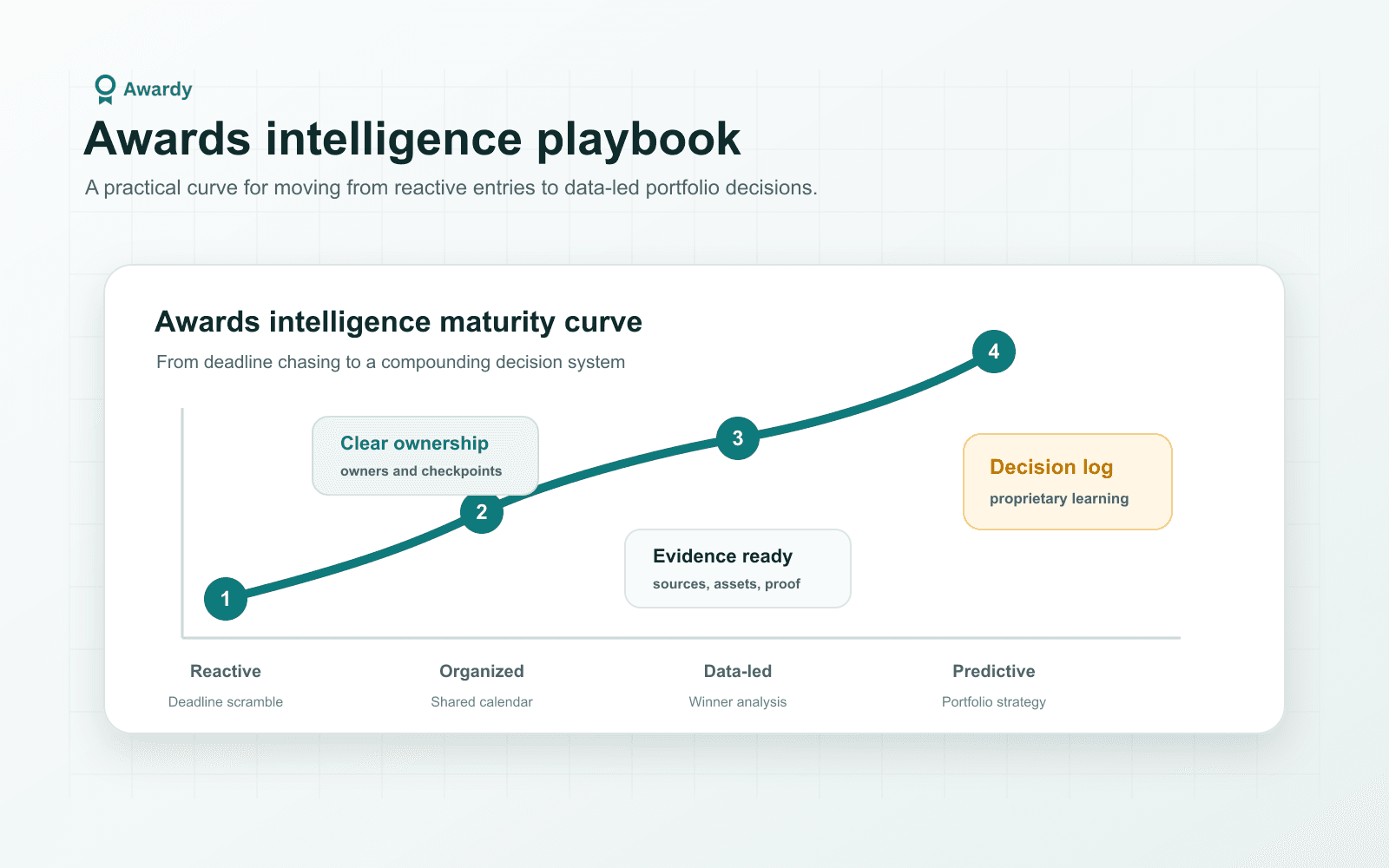
The easiest way to turn awards intelligence into a working system is to assign one owner for each layer of the practice. One person owns program data, one owns the deadline and budget view, one owns category strategy, one owns evidence readiness, and one owns results analysis after each awards cycle. In smaller teams, the same person may hold more than one role, but the responsibilities should still be explicit. Without clear ownership, the practice quietly collapses back into deadline chasing.
A useful monthly rhythm is simple. In the first week, update program and deadline changes. In the second week, review eligible campaign work with account and strategy leads. In the third week, test category fit and evidence gaps. In the fourth week, update the submission slate and budget forecast. This keeps awards strategy connected to current work rather than becoming a separate spreadsheet that only appears when fees are due.
The most valuable output is a decision log. Record why a campaign was entered, parked, or rejected; which category alternatives were considered; what evidence was missing; and whether the result justified the spend. After one full year, that log becomes a proprietary dataset about your own awards performance. It tells you which programs consistently return value, which categories are over-entered, and which clients need earlier evidence planning.
Operating model for teams
To make The Awards Intelligence Playbook for Agencies and Brands useful inside a real agency or brand team, translate the guidance into owners, checkpoints, and artifacts. The owner is the person accountable for keeping the decision live. The checkpoint is the recurring moment when the team reviews progress. The artifact is the document, scorecard, or dashboard that preserves the decision. Without those three pieces, even strong strategic guidance tends to disappear once client work becomes urgent.
A practical operating model has three layers. The leadership layer decides the priority programs, budget envelope, and risk tolerance. The strategy layer decides which campaigns and categories deserve investment. The operations layer turns those decisions into deadlines, drafts, assets, approvals, and payment. Problems usually appear when one layer makes assumptions on behalf of another, so the system should make dependencies visible early.
The most useful artifact is a living slate. Each row should show the campaign, target program, target category, evidence status, asset status, client approval owner, fee tier, and current recommendation. Review the slate weekly during active awards season and monthly outside it. This gives the team enough structure to act without turning awards work into bureaucracy.
Metrics that prove the process is working
The success of The Awards Intelligence Playbook for Agencies and Brands should be measured before award results arrive. Results matter, but wins and shortlists are lagging indicators. Earlier indicators show whether the team is building a healthier awards machine. Track how many candidate campaigns were reviewed before deadlines, how many entries hit early fee windows, how many were killed before payment because evidence was weak, and how many final submissions passed QA without major rework.
Also track quality of evidence. A submission process improves when more cases arrive with approved result sources, clear baselines, usable assets, and documented permissions. If the team repeatedly enters work with missing proof, the issue is upstream campaign measurement rather than entry writing. Naming that clearly helps leadership fund the right fix.
After the season, compare investment and outcome by program, category family, client, and campaign type. Do not only ask what won. Ask which entries deserved to win, which entries were weaker than expected, and which decisions should change next year. This makes the awards process a compounding learning system instead of a set of disconnected deadlines.