
AI assistants are much more useful in awards work when they can ask the right system for facts instead of relying on memory or pasted notes. That is the practical reason behind the Awardy MCP server.
The Model Context Protocol, or MCP, is a standard way for AI applications to connect to external systems. The official MCP documentation describes it as an open standard for connecting AI applications to data sources, tools, and workflows. For awards teams, that matters because deadline data, category context, fee windows, winner references, and case history do not belong in a one-off prompt. They belong in a structured source that an assistant can query when it needs context.
Awardy now has a public MCP connection surface at Connect to AI, alongside the buyer-facing Awards Data for AI Agents page. The immediate use case is simple: connect your AI assistant to Awardy, then ask about award programs, cycles, categories, key dates, fees, winners, and entry requirements without copying data between tabs.
The problem: agents are only as good as their context
Most award workflow failures are not caused by bad writing alone. They are caused by missing context. A strategist asks for category options without the latest category structure. A writer drafts a case without seeing the entry requirements. A team estimates budget from last year's fees. A planner asks an assistant to compare programs, but the assistant has no live source for deadlines or winner records.
In a normal chat workflow, the fix is manual. Someone opens award sites, copies deadlines, pastes category descriptions, adds a note about fees, and asks the model to reason over that pile of text. That can work for one conversation. It does not scale across a team.
MCP changes the operating pattern. Instead of stuffing every prompt with context, the assistant can request structured information from a connected server. For Awardy, that server is the bridge between award intelligence and the AI tools teams already use.
What the Awardy MCP server is for
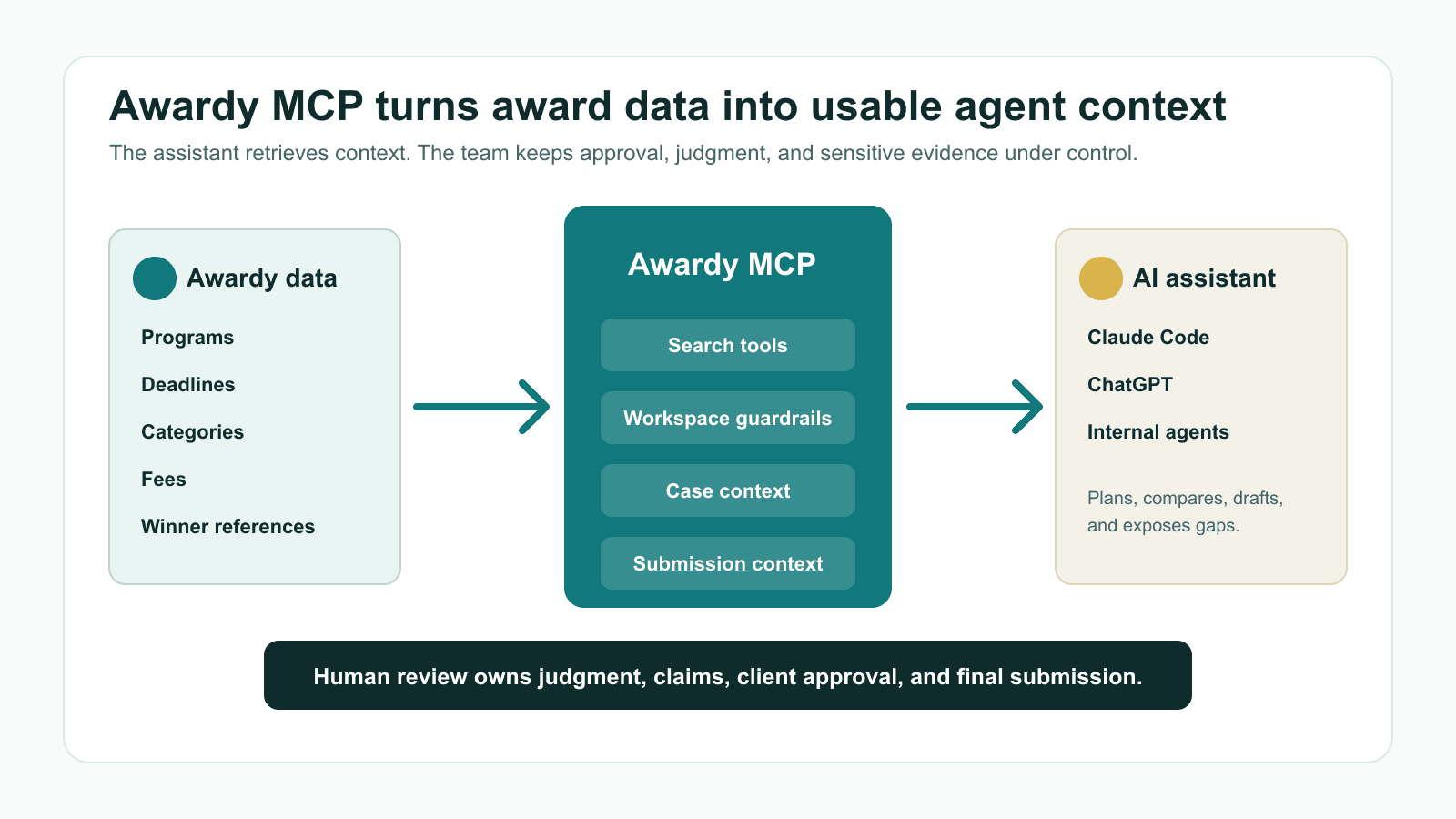
The Awardy MCP server is designed to make awards intelligence available inside AI assistants and agent workflows.
At the planning-data layer, Awardy exposes program search, award profiles, cycles, key dates, categories, fee structures, winner search, winner case references, entry requirements, and unlock requests for gated data. That supports the most common planning questions: which awards fit this campaign, what dates matter this season, which categories deserve inspection, what previous winners looked like, and what deeper data should be unlocked next.
The important distinction is that MCP does not make the assistant the final authority. It gives the assistant a better context layer. Humans still decide which programs to enter, which claims are defensible, which client approvals are needed, and which final narrative should be submitted.
How Awardy MCP works across AI clients
The important point is that MCP is the connection layer. ChatGPT, Claude Code, Codex, and other MCP-capable clients may have different interfaces and user bases, but the Awardy use case is the same: give the assistant a trusted way to retrieve award context instead of asking it to guess from memory.
ChatGPT is likely to be the most familiar surface for business users who want to research opportunities, compare categories, prepare checklists, or pressure-test an entry plan in a conversational workflow.
Claude Code and Codex are more natural surfaces for technical and operations teams that work inside codebases, documentation, structured planning files, or workflow systems. They can use the same Awardy MCP context while helping teams improve intake forms, reporting templates, approval flows, or award-planning documentation.
The platform choice should follow the work. Use the client your team already trusts, connect Awardy as the awards context source, and keep the same human review standard across every surface.
How to connect Awardy in Claude Code or Codex
Claude Code and Codex both support MCP server workflows, which makes them useful when award operations touch technical systems, structured documents, or workflow tooling. Anthropic's Claude Code MCP documentation explains how to add a remote HTTP MCP server. OpenAI's Codex MCP documentation says Codex supports MCP servers in both the CLI and IDE extension, including streamable HTTP servers.
For Awardy, the public server URL is https://mcp.awardy.ai/mcp. In your MCP client, add an MCP server named awardy, set the transport to the supported HTTP option, and use that URL.
After authentication, the assistant can use Awardy as a connected source during planning, documentation, or development work. A practical workflow might look like this: review a campaign intake form, award-planning document, or category-fit template; ask Awardy for target awards, upcoming cycles, and category options; draft a category-fit report or evidence checklist; flag which facts, assets, or approvals are still missing; and keep the final entry decision with the awards lead.
That is a stronger workflow than asking an assistant to invent a submission plan from a generic prompt. The assistant has a job: retrieve, compare, summarize, and expose gaps. The human has a job: judge, approve, and protect the strategic quality of the entry.
How this maps to ChatGPT and other MCP clients
OpenAI's MCP and connectors documentation explains that models can use remote MCP servers and connectors to access external services when needed. For awards workflows, the practical lesson is simple: connect only trusted services and be deliberate about what campaign data is shared.
That is the right lens for Awardy. Award data is useful because it can shape recommendations. Campaign data is sensitive because it can include client strategy, performance results, creative assets, and unreleased claims.
For ChatGPT and other MCP clients, the correct design is not "send everything everywhere." The better design is a permissioned context loop: retrieve public or workspace-approved award data from Awardy, provide only the campaign information needed for the current decision, return a shortlist or checklist, then have a named human review the result.
A practical workflow for award teams
The most useful Awardy MCP workflow is not a single command. It is a repeated operating loop.
Start with the award slate. Ask the assistant to pull programs, cycles, deadlines, and fee windows for the next season. Then ask it to group programs by region, discipline, deadline pressure, and likely relevance to your campaigns.
Move into category selection. For each candidate campaign, ask for the relevant categories and entry requirements. Compare the category language against the campaign's strongest evidence. The assistant can help produce a category-fit scorecard, but the score should be reviewed by someone who understands the work and the client's tolerance for risk.
Then move into evidence. Use the award data to build an evidence checklist: results, baseline, timeframe, creative assets, proof points, permissions, and client approvals. This is where agentic workflows become genuinely useful. They expose missing evidence before the final week, when every fix is more expensive.
Finally, move into writing and review. The assistant can draft outlines, suggest claim structure, and produce reviewer notes. It should also point back to the award requirement it is addressing. A draft that cannot show which category requirement it serves is not ready for human review.
Awardy's broader entry-management workflow is built around this same pattern: access the right awards data, plan the opportunity, create the submission materials, analyze readiness, and connect the work to the people who need to approve it.
What workspace-aware award agents need
Research workflows only need public award context: programs, cycles, categories, fees, deadlines, winner references, and entry requirements. Submission workflows need more care because they touch a team's own cases, drafts, assets, approvals, and review notes.
That is where a workspace-aware assistant becomes valuable. It should be able to answer practical questions: which campaign or case this submission is attached to, which award program and category the team is preparing for, what draft and review notes already exist, which approved materials are available, and which required evidence or approval is still missing.
This need is not specific to ChatGPT, Claude Code, or Codex. The same context standard applies across every client. An assistant cannot responsibly help with an award submission if it cannot see the working context, and it should not see more than the workflow requires.
The operating principle is simple: keep workspace boundaries strict, keep list views lightweight, make detail views deliberate, and expose sensitive materials only when the team has chosen that workflow. That is the difference between connecting an assistant to data and giving a team a dependable award-operations layer.
The guardrails that make agentic award work usable
Awards teams should treat MCP access as a workflow capability, not a shortcut around review.
There are five guardrails worth making explicit: keep sources visible, keep workspace boundaries strict, keep lists light and details deliberate, keep sensitive campaign evidence under human control, and keep approval human.
These rules are not friction for its own sake. They are what make AI-assisted awards work credible. Award submissions involve public claims, client approvals, budgets, legal rights, and reputational risk. The assistant should reduce the operational load without blurring accountability.
What this means for agencies and brands
The biggest shift is from "AI writer" to "award-aware workspace assistant." An AI writer starts with a blank prompt and tries to produce polished copy. An award-aware assistant starts with structured context: program data, category requirements, deadlines, fees, winner references, campaign evidence, entry drafts, reviewer notes, and workspace status.
That distinction changes the work. The assistant is no longer only drafting. It is helping the team answer operational questions: are we entering the right category, what will this cost if we wait, is the submission ready, and what should we do this week?
That is where Awardy should sit in the stack. Not as a loose writing prompt, but as an awards intelligence layer that agents can query while teams keep control of the final decisions.
How to evaluate whether the setup is working
You can judge an MCP workflow before award results arrive.
Track whether the team finds deadlines earlier, catches missing evidence sooner, reduces repeated manual lookup, and makes category decisions with clearer rationale. Track whether fewer entries reach final review with unresolved claim sources, missing assets, or confused category fit. Track whether the assistant's recommendations include source context instead of generic advice.
A healthy workflow produces better questions as much as better answers. If the assistant can ask, "Which case is this submission attached to?", "What award and category is it for?", "Has the review module already run?", and "Which media assets are available?", the team is closer to a real operating system for awards.
Next step
If your team is experimenting with award-aware AI workflows, start with a narrow use case: program research, category shortlisting, or evidence readiness. Connect Awardy through the MCP page, test the workflow with a non-confidential campaign, and inspect every recommendation before using it in client work.
Awardy is the awards intelligence platform that helps agencies, brands, and award programs access awards data, plan opportunities, generate insights, and turn campaigns into stronger entries. The MCP server is one way that intelligence becomes available where teams already work: inside the assistants, agents, and developer tools that are becoming part of the awards workflow.
The goal is not to remove people from award decisions. The goal is to stop wasting their attention on repeated lookup, fragmented context, and preventable workflow gaps.