
As of 20 June 2026, the next Effie Awards Europe deadline is 30 July 2026.
That is the date on the calendar. It is not the first real decision.
The first real decision is track fit.
Effie Europe 2026 is not one flat category list where every strong case simply picks the nicest label. Multi-market and special categories use one fee ladder. Best of Europe uses another. Eligibility windows change by path. Category caps change by path. One wrong assumption can turn an award-worthy case into an expensive detour.
You did the effectiveness work. Do not lose time, budget, or confidence because the entry started in the wrong lane.
The smarter workflow is simple: track first, evidence second, category third, and fee math before the invoice.
The Effie Europe 2026 dates to know
According to the official call for entries page, the 2026 Effie Awards Europe entry season runs from June through 10 September 2026.
- 1st deadline: 30 July 2026.
- 2nd deadline: 13 August 2026.
- 3rd deadline: 27 August 2026.
- 4th deadline and final deadline: 10 September 2026.
The same page lists the judging and outcome timeline:
- Round 1 judging starts on 25 September 2026.
- Round 2 judging is scheduled for the end of October 2026.
- Finalists are expected at the end of October 2026.
- Winner notifications are scheduled for early November 2026.
- Grand Jury and Effie Day are both listed for 3 December 2026.
The practical takeaway is not that you have until 30 July.
You do not.
If the track is not settled, the evidence is not clean, and the category plan is still being debated in mid-July, your team is already sliding toward the more expensive rounds.
That is where deadline panic starts. Awardy prefers receipts.
What the Effie Europe 2026 fee ladder means
Effie Europe 2026 does not use one universal fee table. The official call for entries page separates multi-market and special categories from Best of Europe.
That split matters because it changes the budget before the team even gets to category multiplication.
Multi-market and special categories
For multi-market and special-category entries, the published fees are:
- 30 July 2026: EUR 995 for EACA members and EUR 1,895 for non-members.
- 13 August 2026: EUR 1,495 for EACA members and EUR 2,295 for non-members.
- 27 August 2026: EUR 1,595 for EACA members and EUR 2,395 for non-members.
- 10 September 2026: EUR 1,695 for EACA members and EUR 2,495 for non-members.
The same official page says non-profit category entries receive a 50% discount. It also warns that unpaid entries are withdrawn if the fee is not paid before first-round judging begins on 25 September 2026.
Translation: the entry is not truly finished until the fee is handled.
Best of Europe
Best of Europe uses a lower fee ladder:
- 30 July 2026: EUR 845.
- 13 August 2026: EUR 1,095.
- 27 August 2026: EUR 1,195.
- 10 September 2026: EUR 1,295.
There is one detail teams should not miss. The official page says that if a Best of Europe entry comes from a country without a local Effie program and is submitted as a non-Effie winner, the multi-market fees apply instead.
That is the kind of technicality that makes budget sheets lie.
Before anyone adds two extra categories because the case feels broad, confirm the track. Is this multi-market? Special category? Best of Europe Gold or Grand winner? Non-Effie-market Best of Europe case?
Right track first. Then price the slate.
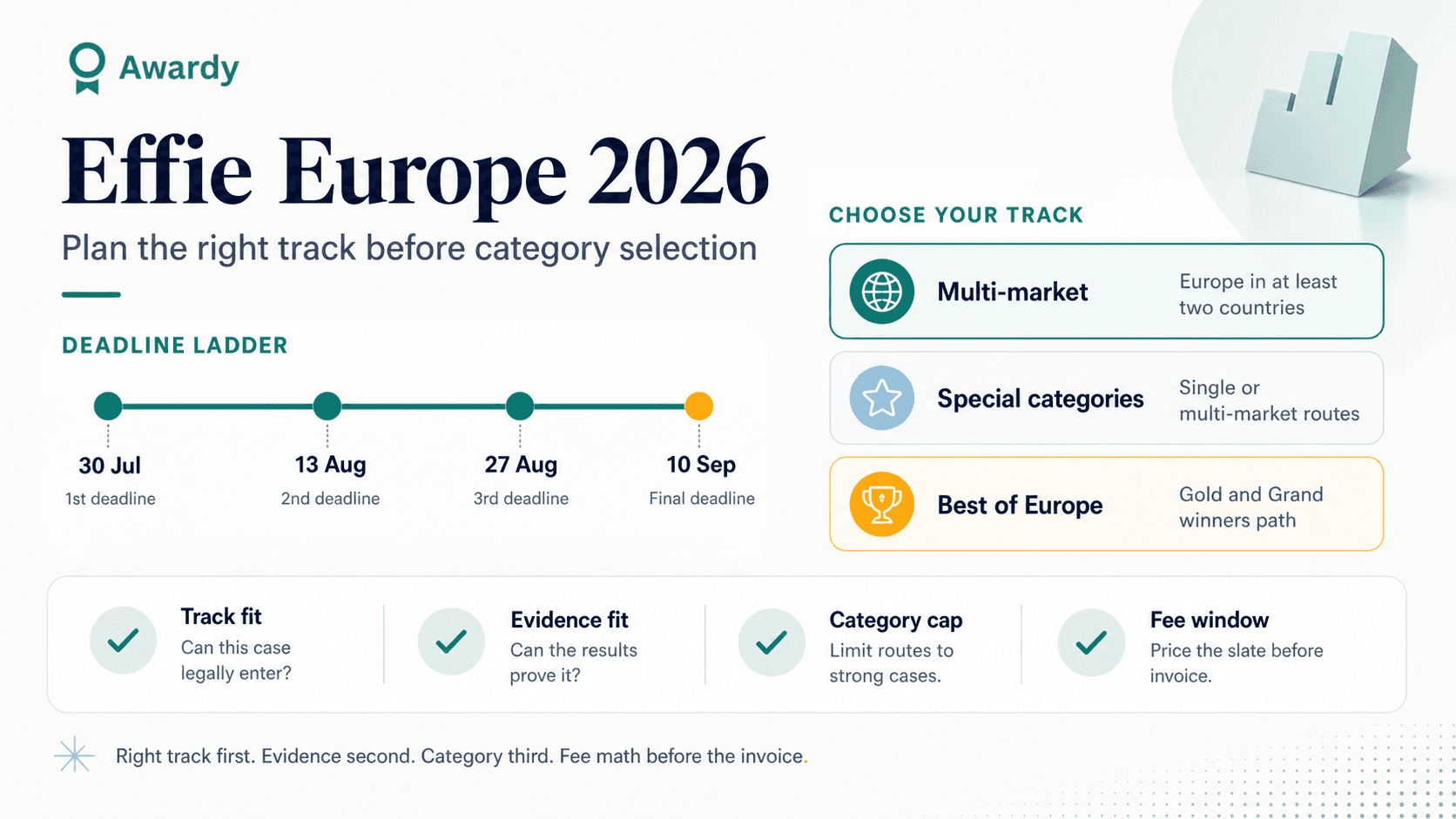
How Effie Europe organizes categories in 2026
Effie Europe 2026 is built around three entry paths: multi-market categories, Best of Europe categories, and special categories.
The official call for entries page says multi-market categories are open to campaigns that ran in at least two countries in Europe between 1 January 2025 and 31 March 2026. It says special categories are open to single-market and multi-market campaigns that ran in Europe during the same date range.
The separate Best of Europe page uses a different rule set. Best of Europe is open to 2025 Gold and Grand Effie winners from local Effie programs. It is also open to campaigns from countries without a local Effie program if those efforts ran between 1 January 2024 and 31 March 2026.
That is the first category lesson.
Effie Europe is a track system.
If your team starts by debating whether the case belongs in AI, commerce, social, or retail before deciding which Effie Europe path it can legally and strategically enter, you can spend days polishing the wrong entry.
The official multi-market categories page also gives the category cap. A case can be entered into a maximum of four categories in the multi-market system. That can be one industry category and three specialty categories, or four specialty categories. Each category requires a separate entry and a separate fee.
Best of Europe is tighter. The official Best of Europe page says campaigns can be entered into a maximum of two categories, and only one of those may be an industry category. Teams can skip the industry route and enter two specialty categories instead.
Caps are not targets.
Four available routes does not mean four smart routes. Two available Best of Europe categories does not mean two strong arguments. Pay for the routes where the evidence actually changes.
The 2026 category updates that matter
The official 2026 open-for-entries announcement highlights several new or newly emphasized 2026 categories, including Civic Engagement & Democracy, Decades of Sustained Success, Restaurants, Business Achievement, Brand Content & Entertainment, Brand Integration & Partnerships, and Retail Media.
New labels are useful. They are also tempting.
Do not chase novelty just because a category sounds current. A Retail Media entry still needs retail-media logic. A Business Achievement entry still needs a business-goal-centered case. A Civic Engagement & Democracy entry needs effectiveness tied to that civic or institutional outcome.
The right category should make the work easier to understand, not harder to defend.
That is the whole point.
The track-first shortlist
This is the operator screen we would use before putting any Effie Europe case into the paid queue.
1. Confirm the track before the category
Ask one blunt question first:
Is this truly multi-market, truly special-category eligible, or truly Best of Europe?
If the answer is fuzzy, stop there. You do not have a category problem yet. You have a track problem.
2. Confirm the evidence window
The official call for entries page includes one useful nuance: results can be collected outside the eligibility period, but they must tie directly to the marketing activity within the eligibility time frame.
That means a later result is not automatically disqualifying. It does need a clean evidence chain.
No chain. No confidence.
3. Confirm the category cap before cloning entries
Multi-market gives you up to four category submissions. Best of Europe gives you up to two. Those are hard caps, not a shopping list.
Only multiply entries when the case angle truly changes and the evidence still feels built for each route. If the same argument is being stretched across several labels, the extra fees are probably buying dilution.
4. Confirm the case can survive the deadline ladder
The fee jump from 30 July to 13 August is material, especially for non-members. A case that is still unresolved by late July should not automatically roll into the next paid window.
Sometimes the right move is to narrow the slate. Sometimes the right move is to pay for more time because the evidence will get stronger.
The point is to decide. Do not drift.
This is the same discipline behind Awardy's how to budget for awards and the broader 6-step award submission workflow. The budget decision is not separate from the quality decision. It is usually the same decision wearing a different hat.
Common mistakes teams make with Effie Europe
The first mistake is treating all Effie Europe entries as if they share one pricing model.
They do not.
The second mistake is confusing a broad European footprint with multi-market readiness. If the campaign ran across Europe but the evidence, market logic, or narrative only really works for one market, the case may still be fragile.
The third mistake is using category caps as a target. Four possible routes in multi-market does not mean four worthwhile routes.
The fourth mistake is forgetting that Effie Europe is an effectiveness competition first. The official materials keep pointing entrants back to measurable outcomes, business context, and proof.
If the team still cannot tell a clean results story, category experimentation will not save the entry.
For a related view on evolving Effie structures, connect this guide with Effie Awards 2026 Category Changes: What You Need to Know.
Where Awardy fits in an Effie Europe workflow
Effie Europe is exactly the kind of program where structured planning beats heroic last-minute writing.
You need clean dates. Fee visibility. Track logic. Category discipline. One place to hold evidence before reviews begin.
Start with the Awards Calendar to keep the 30 July and 13 August milestones visible. Use the Awards Directory to compare Effie Europe with other European and effectiveness-focused options. If the case is moving forward, bring it into a controlled entry management workflow so the proof, owners, and review steps are not scattered across decks, email, and chat threads.
Awardy reads the deadlines, categories, and eligibility rules so teams can spend more time protecting the case and less time chasing the admin around it.
If you want help building the shortlist before the first deadline, join the waitlist or request access to Awardy.
The point is not to enter more.
The point is to enter the right work, in the right track, with evidence the judges can trust.