
As of 4 July 2026, the key Felis Awards dates are already public even though the full 2026 rules are not.
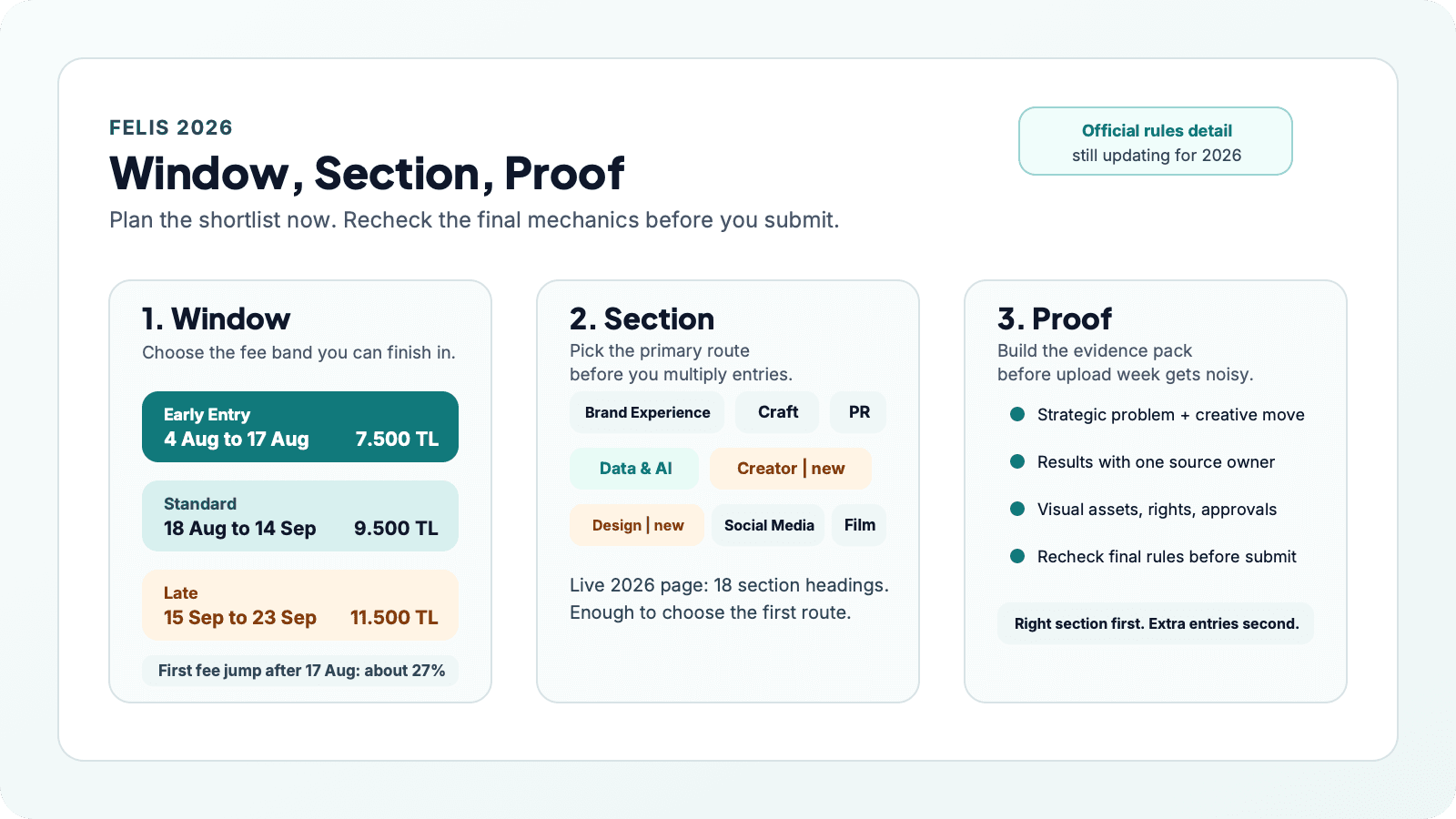
Entries open on 4 August 2026. The Early Entry window runs through 17 August at 7.500 TL + KDV. The Standard window runs from 18 August through 14 September at 9.500 TL + KDV. The Late window runs from 15 September through 23 September at 11.500 TL + KDV.
That gives you a real planning window. It does not give you permission to drift.
The useful detail on Felis right now is not only the fee ladder. It is the combination of three facts: the dates are live, the 2026 sections page is live, and the official rules page still says new-period details are being updated.
You can lock your shortlist now. You should still keep one final rules check close to submission.
The Felis 2026 dates and fees that matter now
The official Felis homepage and the official 2026 launch news post match on the current sequence:
- Project eligibility period: 15 September 2025 to 23 September 2026.
- Early Entry window: 4 August to 17 August 2026 at 7.500 TL + KDV.
- Standard Entry window: 18 August to 14 September 2026 at 9.500 TL + KDV.
- Late Entry window: 15 September to 23 September 2026 at 11.500 TL + KDV.
- Jury pre-evaluation: 2 October to 12 October 2026.
- Final evaluation meetings: 15, 16, 20, 21, and 23 October 2026.
- Awards ceremony: 4, 5, and 6 November 2026.
For most teams, the practical checkpoint is 17 August.
If the entry is not directionally complete by then, you are not only paying more. You are also compressing the time left for section checks, asset cleanup, approvals, and translation nuance if your source materials are mixed.
The fee math is not trivial:
- 7.500 TL to 9.500 TL is a 27% increase.
- 9.500 TL to 11.500 TL is a 21% increase.
- 7.500 TL to 11.500 TL is a 53% increase.
That matters even more when one case is likely to spawn multiple entries.
Before you clone one campaign across the slate, pressure-test the cost in your awards budget planning guide. Cheap early windows can still produce expensive weak entries.
What the official 2026 sections page confirms already
The official Felis sections page is already useful, even though it is still being updated.
It currently lists 18 live section headings for the 2026 cycle:
- Brand Experience Felis.
- Craft Felis.
- Creative Commerce Felis.
- Creator Felis.
- Data & AI Felis.
- Design Felis.
- Digital & Mobile Felis.
- Entertainment Felis.
- Film Felis.
- Healthcare & Wellness Felis.
- Integrated Felis.
- Media Felis.
- Outdoor Felis.
- PR Felis.
- Print & Publishing Felis.
- Radio & Audio Felis.
- Social Media Felis.
- Social Responsibility & Sustainability Felis.
Two details stand out right away.
First, the page marks Creator Felis and Design Felis as new. That is not a small editorial footnote. It changes where newer creator-led and design-led work may belong.
Second, the section list is already enough to stop the usual shortlist mistake: trying to make one case live everywhere.
Different work wants different judges. A strong data-and-effectiveness story may have a cleaner route in Data & AI Felis than in a broader integrated bucket. A creator-led idea may need a different proof set from a classic film or social case. A design-heavy system may deserve its own route instead of being buried inside a brand campaign write-up.
Right section first. Extra entries second.
If you want a Turkish-market comparison point while you shortlist, the existing Kristal Elma structure guide is a useful cross-check for how section logic can reshape an awards slate.
The missing detail matters too: the rules page is still updating
The official rules page says the 2026 calendar and participation fees have been updated, and that new-period rules and details are still to come.
That line should change how you work.
Do not read it as a blocker. Read it as a sequencing note.
You already have enough information to decide which cases belong on the Felis shortlist, estimate the fee exposure, assign owners, and choose the most likely primary section.
You do not yet have a clean reason to guess at every final mechanics question.
So the planning move is simple:
- Shortlist now.
- Gather proof now.
- Verify final entry mechanics again when the detailed 2026 rules copy is fully updated.
That is the same discipline we recommend in the 6-step award submission workflow. Strategy early. Compliance late, but not too late.
Use the Window, Section, Proof screen before you pay
This is the Awardy framework we would use on Felis right now.
1. Window
Ask one blunt question first: can this case be submission-ready by 17 August?
Submission-ready does not mean the team likes the idea of entering. It means the story, evidence, credits, language, and key assets are coherent enough to survive upload and review without panic.
If the answer is no, treat 18 August as a deliberate fee decision. Do not pretend it is still the cheap route.
2. Section
Choose one primary section before you discuss spin-off entries.
A lot of award waste comes from the opposite order. Teams see a long list, get excited, and start multiplying routes before they have named the one section where the work is most naturally judged.
For Felis 2026, the live section list already gives you enough to sort the board:
- Experience-led work.
- Craft-led work.
- Creator-led work.
- Data-and-AI-led work.
- Design-led work.
- Channel-led work.
- Impact-led work.
Once that primary route is clear, secondary routes become easier to defend.
3. Proof
Because the full 2026 rules detail is still updating, the proof pack matters more than usual.
Create a simple evidence file for every shortlisted case:
- One paragraph on the strategic problem.
- One paragraph on the creative or execution move.
- Results with the exact source owner noted.
- The likely visual asset set.
- Any legal, rights, language, or client-approval risks.
If that file already looks thin, the fee band is not the problem. The case is.
This is where an entry-management workflow earns its keep. The goal is not more entries. The goal is more finished entries that still make sense when the judges read them.
A practical Felis shortlist plan for July
If your team is planning before the 4 August opening, use this sequence:
- Pull every case that fits the official 15 September 2025 to 23 September 2026 project window.
- Group each case under one primary Felis section, not three.
- Mark which cases can realistically clear the 17 August early window.
- Assign one proof owner per case for results, assets, and approvals.
- Recheck the official rules page before final submission in case detailed 2026 mechanics, forms, or material expectations change.
This is also a good moment to review which cases deserve a larger intelligence pass. If the team needs a broader comparison of sections, deadlines, and award-fit across markets, that is where Awardy's awards-data-for-AI workflow is useful. It gives you one place to compare routes instead of reopening every program page from scratch.
The real Felis 2026 planning question
The question is not whether Felis is open yet.
The question is whether your team can turn the right work into the right section with the right proof before the 17 August fee jump.
That is the point where the planning edge disappears.
Felis has already published enough for serious teams to start. It has not published enough to justify lazy assumptions on final mechanics. Those are different things.
Start the shortlist now. Keep the final rules check late enough to be accurate and early enough to still matter.
If you want help tracking fee windows, section fit, and entry readiness in one place, join the Awardy waitlist.