
As of 25 May 2026, Golden Drum 2026 is in its Early Bird window, with just over three weeks left before the 17 June fee cutoff. The final submission deadline is 26 August 2026 at 23.59 CET. If you are considering the festival this year, the useful question is not only whether the work is good enough. It is whether the work belongs in your entry shortlist before the fee band changes.
The official Golden Drum 2026 materials also make the category structure clear. The competition is divided into five main sections, plus an All Juries section for specific themes. That means teams should decide section fit before they start cloning entries, because the category path affects cost, asset prep, and how much rewriting the case will need later.
The key Golden Drum 2026 dates to know
The official Golden Drum FAQ and the competition overview give the working calendar for 2026. For practical planning, the dates that matter most are these:
- Call for entries opened on 10 March 2026.
- Early Bird fee window closes on 17 June 2026.
- Final entry deadline is 26 August 2026 at 23.59 CET.
- Shortlists are scheduled for 29 September 2026.
- Winners are announced on 13 October 2026 during the Golden Drum Awards Show.
Eligibility is also specific. According to the eligibility rules, entries must have been aired, published, or implemented for the first time between 23 August 2025 and 26 August 2026, with a special exception for Brand Vitality in the Brand Building area. If a campaign sits outside that window, no amount of polishing will save the entry.
How Golden Drum organizes categories in 2026
Golden Drum is not one flat list of categories. The official competition overview says the 2026 program is split into five main sections: One-Channel, Omni-Channel, Craft, Creative Media Excellence, and Creative Business Excellence. Separate from those, the festival also runs the All Juries section for themed groups such as local spirit, social good, inclusion, and work that challenges established advertising norms.
That structure matters because it changes how a piece should be framed. One-Channel is for work whose strength lives in one communication channel. Omni-Channel is for integrated campaigns that need multiple channels to tell the full story. Craft is about execution quality. Creative Media Excellence rewards smart media use. Creative Business Excellence is where business model, customer experience, and innovation logic become the center of the case.
The group names reinforce that distinction. One-Channel includes Film, Print, Out of Home, Audio, Digital, Mobile & Technology, and Design. Omni-Channel includes Integrated, Content, Engagement, Digital, Mobile & Technology, Health & Wellness, and Sports, Pop Culture & Art. Craft is broken into Industry Craft, Motion Craft, Digital Craft, and Innovation Craft. If you are still debating whether the work is a category problem or a story problem, Golden Drum usually answers it for you by the section you are forced into.
This is also where teams overspend. The eligibility rules say a single entry can be registered up to three times within the same group in One-Channel and Omni-Channel. They also allow multi-category submission patterns inside Craft and parts of Creative Media Excellence. That is useful, but it is also where teams start paying for category duplication that does not improve win probability.
What the fee windows mean for planning
Golden Drum is a good example of why award budgeting should start before final drafting. The festival uses three fee windows: Super Early Bird, Early Bird, and Standard. The current live question is simple: do you want your likely entry shortlist approved before 17 June, or are you comfortable paying the next price band for the same shortlist?
The official One-Channel fees page currently lists common One-Channel categories at 350 EUR in the Super Early Bird window until 22 April 2026, 390 EUR in the Early Bird window until 17 June 2026, and 450 EUR in the Standard band after the 17 June cutoff, with the fee page itself labeling that line from 18 June 2026 onward. The same page also shows Mastercard pricing at 330 EUR, 370 EUR, and 430 EUR for those categories, and notes that the quoted entry prices do not include 22% VAT. Exact prices vary by section and payment route, so teams should always confirm the relevant live page before checkout rather than assuming one section matches another.
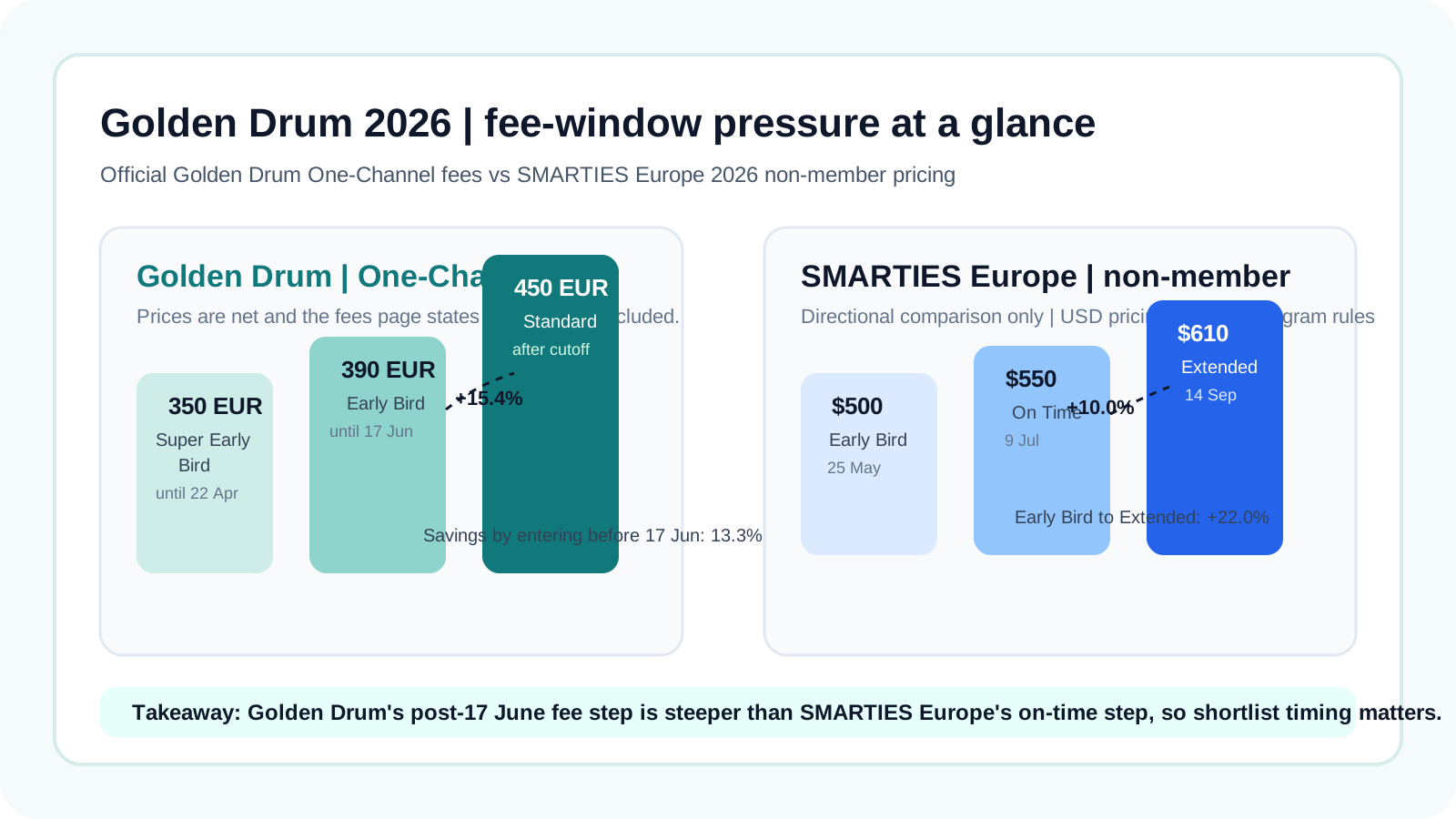
The percentage jump is the part worth paying attention to. Missing the 17 June 2026 Early Bird cutoff moves the standard One-Channel rate from 390 EUR to 450 EUR, which is a 15.4% increase. Relative to the Super Early Bird level, the full movement from 350 EUR to 450 EUR is 28.6%. Put another way, entering by 17 June saves 13.3% versus the Standard band, while entering by 22 April saves 22.2% versus the Standard band. On the Mastercard path, missing the 17 June cutoff moves the fee from 370 EUR to 430 EUR, which is a 16.2% increase.
For directional context from another program in Awardy's current database, the official SMARTIES Europe 2026 non-member fee moves from 500 USD at Early Bird to 550 USD on-time and 610 USD at Extended. That is a 10.0% increase from Early Bird to on-time and a 22.0% increase from Early Bird to Extended. It is not a like-for-like comparison because the currency, membership rules, and program structure differ, but it shows a useful pattern: both programs penalize delay, though Golden Drum's jump after the 17 June cutoff is steeper than SMARTIES Europe's on-time step.
There are two operational details worth noticing in the official press release. First, for every 10 entries submitted, the entrant receives one complimentary delegate pass. Second, Ukrainian entrants are entitled to a 50% discount on entry fees. Neither detail changes the core submission strategy, but both affect real budget planning if a group portfolio is being assembled instead of a single flagship case.
This is why our working rule at Awardy is to treat a late-fee program as a shortlist-design problem, not a writing problem. Most teams lose money before they lose time. They approve too many borderline category variants, then try to rationalize the spend by forcing more entries through the system. The cleaner move is to decide the entry shortlist early, then improve the few entries that actually deserve the fee.
A practical framework for the final weeks before the Early Bird cutoff
If you are planning in the final weeks before the 17 June cutoff, use a simple four-step pass. This is the framework we would apply internally before giving a campaign the green light for Golden Drum.
1. Confirm the eligible work
Check the first-publication date, market, ownership, and client permission first. Golden Drum requires advertiser or rights-owner consent. If those approvals are not real yet, the entry is not ready no matter how strong the work looks in a deck.
2. Cluster the category logic
Do not start from a giant category list. Start from the strongest angle of the work. Is the main case about one standout execution, a multi-channel system, craft quality, smart media use, or a business solution? If your answer is fuzzy, the case is not ready to multiply across categories yet. Use the Category Recommender to pressure-test the shortlist before the team starts cloning entries.
3. Cost the entry shortlist
Turn every proposed category into a costed line item before anyone says yes. This sounds obvious, but it is the step many teams skip when they are in a creative rush. Use the Budget Calculator for fee modeling and compare the current fee window against the likely standard-rate cost if the shortlist slips. The delta is often large enough to force a better prioritization conversation.
4. Clear the materials and review path
Golden Drum requires more than a narrative. You need the right entry materials, the right credits, and a clean review path. The generic rule is simple: if the evidence, captions, rights, and case framing are still spread across email threads, the entry is not production-ready. Use the entry management workflow to centralize owners, source files, and final approvals before the fee window closes.
Common mistakes teams make with Golden Drum
The first mistake is treating the Early Bird fee deadline like the final submission deadline. It is not. The 17 June date is a pricing decision point. If your likely entries are already clear, waiting does not improve the case. It only changes the fee band. That is why a short, disciplined approval loop often beats a longer, messier drafting cycle.
The second mistake is confusing category abundance with category opportunity. Golden Drum gives you room to enter across sections and groups, but that freedom only helps when each category angle is genuinely different. If the same proof, the same narrative, and the same execution logic are being stretched across too many entries, the team is paying for repetition instead of increasing relevance.
The third mistake is leaving operational checks until the end. The entry that fails late is usually not the one with the weakest creative work. It is the one missing a rights signoff, a proof source, a clean credit list, or a final version of the supporting materials. The 6-step award submission workflow and the broader awards budgeting guide both matter here because the operational burden is part of the real cost.
Where Awardy fits in a Golden Drum workflow
Golden Drum is exactly the kind of program where fragmented planning hurts. You need the official dates, a clean category view, a budget model, and a review workflow that keeps humans accountable for the final call. That is the problem Awardy is built for: connecting award data, planning tools, and AI-assisted drafting support without pretending that the model should be the final authority on facts or spend.
Start with the Awards Calendar to track official milestones, use the Awards Directory to keep program context in one place, then move the shortlisted entries into a structured workflow. If your team wants help building that operating system, join the waitlist or request an intelligence report before the fee window changes again.