
As of 27 June 2026, the next live MENA Search Awards pricing checkpoint is the Super Early Bird deadline on 16 July 2026.
That is the cheapest current window. It is not the planning deadline most teams should trust.
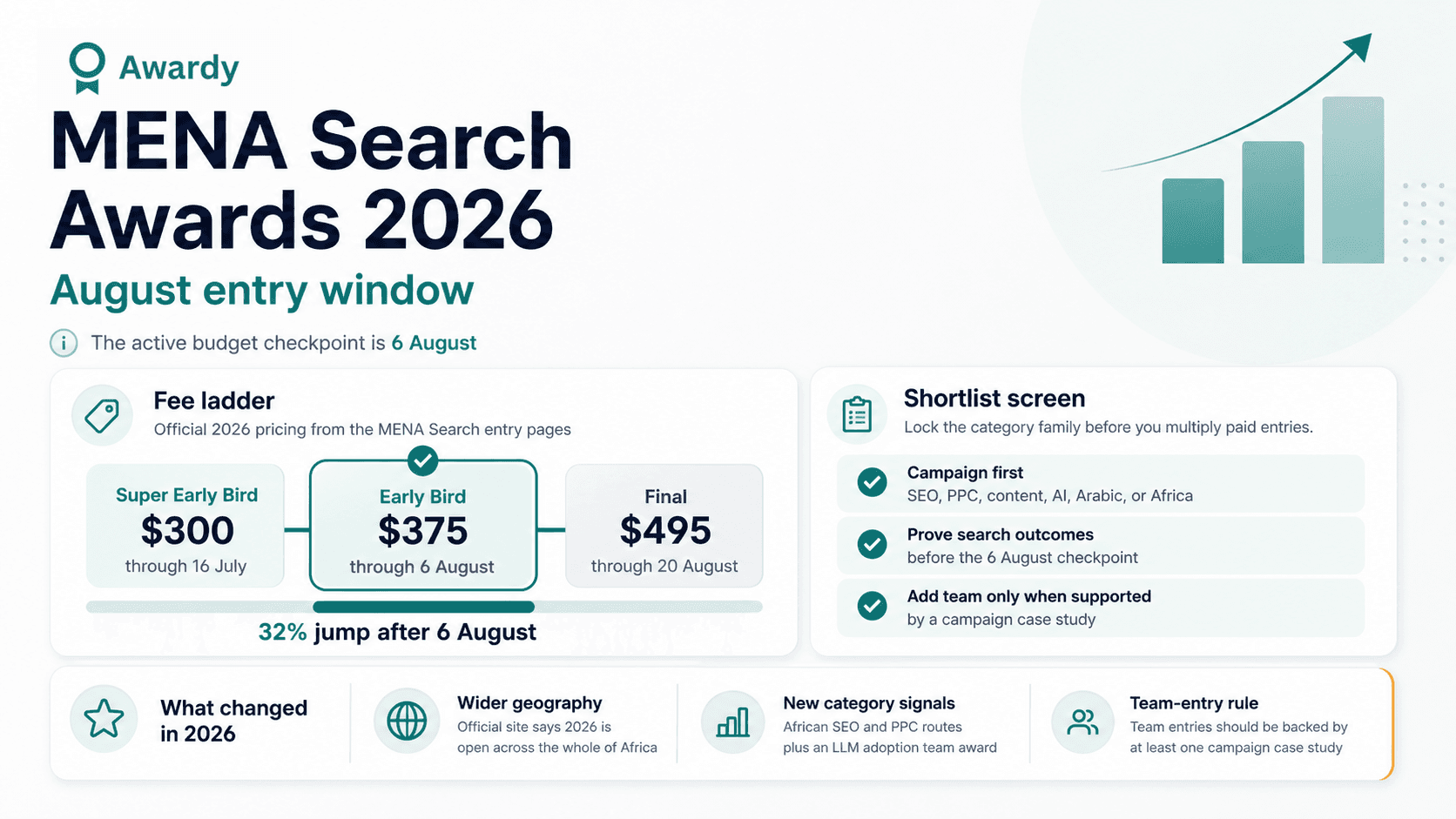
The more useful decision date is 6 August 2026, when the official Early Bird window closes. The official fee ladder shows a standard entry at 300 USD through 16 July, 375 USD through 6 August, and 495 USD after that. Missing 6 August means paying 32% more for the same entry.
You still have time. Do not use that as an excuse to drift.
The 2026 program is also bigger than a basic deadline post. The official site says entries are now open across the whole of Africa, and the category list has new routes that change the shortlist: AI-specific campaign awards, a new LLM adoption category for agencies and in-house teams, and software awards beside the usual campaign and team tracks.
So the first planning decision is not the category name.
It is the category family.
Campaign, software, or team. Pick the lane before you pay for the entry.
The MENA Search Awards 2026 dates that matter now
The official Entry Fees and Rules, The Event, and Terms and Conditions pages align on the current sequence.
- Super Early Bird deadline: 16 July 2026.
- Early Bird deadline: 6 August 2026.
- Final deadline: 20 August 2026.
- Judging session: 16 September 2026.
- Shortlist announcement: 17 September 2026.
- Winners announcement: 11 November 2026.
From a 27 June planning view, the Super Early Bird price is still available. That creates a useful pressure test.
Can the team finish a clean, evidence-backed entry by 16 July?
If yes, the entry can stay at 300 USD.
If not, the next real checkpoint is 6 August at 375 USD. After that, the same entry moves to 495 USD.
The terms page also matters because it removes the comfortable "we will sort it out later" assumption. The organisers say entries submitted after 23:59 on Thursday, 16 July 2026 are charged the Early Bird fee, entries submitted after 6 August are charged the Final fee, and late entries may still be accepted at the organisers' discretion with an extra 25 USD late fee per entry.
There is no magic late window. There is only a decision.
What the fee ladder really means
The official fee ladder is simple:
- Super Early Bird: 300 USD.
- Early Bird: 375 USD.
- Final: 495 USD.
The jump from Super Early Bird to Early Bird is 25%. The jump from Early Bird to Final is 32%. The full move from 300 USD to 495 USD is 65%.
That math starts to bite when the slate gets cloned across categories.
A single late entry may still feel manageable. Four or five late-finalized entries do not feel casual for long. This is why we treat August deadline guides as portfolio decisions, not single-entry reminders.
Before you add more routes, model the total slate in your awards budget workflow. Decide which cases are strong enough to carry the higher fee band. Do not buy extra chances for a weak proof set.
The same official fees page offers one meaningful cost lever: enter five submissions in one session and receive one additional free entry.
Good incentive. Bad excuse.
Use it only if the slate is already coherent. Do not add weak entries just to reach the discount.
How MENA Search organizes categories in 2026
The official Award Categories page makes the structure clear: this is not one flat list of search awards. It is a track decision.
1. Campaign categories
The campaign section spans sector-specific search awards, local and low-budget categories, integrated and tactic-led categories, Arabic content routes, AI-specific categories, and the new African SEO and PPC campaign routes.
The judges are not only looking for generic performance gains. They are segmenting by market context, language, platform mix, and budget reality.
If the work wins because of regional Arabic-language nuance, do not bury that inside a broad PPC story. If the work wins because the team delivered uncommon results on a constrained budget, the low-budget category may be the sharper route.
Right context. Cleaner case.
2. Innovation and software categories
The same official page breaks out software awards such as Best Software Innovation, Best SEO Software Suite, Best PPC Management Software Suite, Best Search Software Tool, Best Use of AI Search Software Solution, and Best Use of AI for Data.
Software entries are not judged like client campaigns.
If the differentiator is the tool itself, the entry needs product proof, adoption logic, and measurable impact from the software. If the differentiator is campaign execution, the campaign should stay a campaign.
Do not force a product story into a campaign box. Do not force a campaign story into a product box.
3. Agency, team, and individual awards
The agency and team track includes Emerging Talent Award, Best Start-Up Agency, Best In-House Team, small and large SEO and PPC agency categories, integrated agency categories, and one especially current addition: Best LLM Adoption & Integration By An Agency/In-House Team.
The official wording on that new category asks entrants to show how they trained their people, integrated LLM workflows across tasks such as content, keyword research, and data analysis, and governed AI use with quality control and efficiency evidence.
This is not an "we tried AI" award. It is an operating-model award.
The same section includes one practical rule many teams will miss: for agency and team categories, at least one supporting case study should also be entered into at least one campaign category. That is why we recommend a campaign-first shortlist before team awards.
Campaign proof first. Team story second.
A better way to shortlist entries before 6 August
For MENA Search 2026, use a four-step screen before any entry earns a paid slot.
1. Lock the category family first
Start by asking whether the work is primarily a campaign, a software product, or an agency or team story. Only after that should you choose the specific category name.
2. Prove the case with measurable search outcomes
The category descriptions repeatedly ask for visibility, engagement, conversions, ROI, or measurable performance impact. If the case cannot show a clean before-and-after story with credible business evidence, it is not ready yet.
3. Support team awards with a real campaign entry
Because the official page says team and agency categories should be backed by at least one campaign case study, enter the strongest campaign first. Then ask whether that proof also supports a team or agency award.
4. Treat 6 August as the go or no-go checkpoint
If the case is not ready by the Early Bird cutoff, be honest about whether another two weeks will materially improve it.
Sometimes the right move is to pay the Final fee because the evidence will get stronger. Sometimes the right move is to cut the slate and protect budget.
The deadline should force that decision instead of letting it drift.
What changed in 2026, and where to be careful
One of the strongest official 2026 signals is that the MENA Search Awards are now accepting entries from the whole of Africa. The news page and homepage both use that language, and the categories page adds new African SEO and PPC awards.
There is one nuance worth stating clearly. Some category copy still refers to campaigns delivering results to the MENA audience, while the broader 2026 site language says the program has widened across Africa.
My reading from the official pages is that the geographic expansion is real, but teams with campaigns centered outside the traditional MENA footprint should still confirm final category fit with the organisers before paying for fringe or ambiguous entries.
That is not a blocker. It is a place to avoid guessing.
The new LLM adoption category is also easy to misunderstand. This is not simply "we used AI internally." The official wording asks for evidence of training, governance, adoption, and efficiency gains.
Common mistakes teams make with MENA Search entries
The first mistake is treating 6 August as only a discount date. It is really a readiness checkpoint. If the evidence deck, case narrative, and category rationale are still unstable, the extra time may be worth more than the saved fee.
The second mistake is multiplying categories before the first case is solid. A broader slate only helps when the underlying story is strong.
The third mistake is entering a team award before a campaign award. The official support-case expectation means the campaign proof should come first.
The fourth mistake is assuming every AI-flavored story belongs in the LLM adoption or AI categories. The category page is more specific than that. The judges want operational evidence and measurable outcomes, not trend language.
What to do this week if you plan to enter
- Confirm whether 16 July, 6 August, or 20 August is your realistic boundary.
- Map each candidate case to one category family.
- Cut every case that cannot prove measurable search impact.
- Decide whether any team award is genuinely supported by a campaign case.
- Run the shortlist through your entry management workflow, budget plan, and submission process.
If you want a clearer way to manage deadlines, category fit, and entry readiness across awards, join the waitlist or request access to Awardy.
The goal is not to generate more entries.
The goal is to spend time and budget on the right ones.