
As of 1 June 2026, the next SMARTIES Europe deadline is the On-Time deadline on 9 July 2026. If you missed the 25 May Early Bird cutoff, the non-member fee is now 550 USD per entry and rises to 610 USD after 9 July. Member pricing is now 495 USD and rises to 555 USD after the same cutoff. If you are building a July entry plan, the real task this week is not generating more longlists. It is deciding which cases are strong enough to survive the paid shortlist.
The official SMARTIES Europe materials are useful because they frame the competition around measurable business impact, not only creative flair. The overview says campaigns are judged on strategy, execution, creativity, and verified impact, which means weak results evidence usually hurts faster here than it would in a more purely craft-led program. That changes how teams should triage work in June.
The key SMARTIES Europe 2026 dates to know
The official eligibility and fees page, program overview, and FAQ give the working timeline:
- Call for entries opened on 24 March 2026.
- Early Bird closed on 25 May 2026.
- On-Time deadline is 9 July 2026.
- Extended deadline is 14 September 2026.
- Eligible campaigns must have run from January 2025 to the end of June 2026.
- The FAQ says the shortlist is expected in mid-October 2026.
On 1 June, the active decision point is the shift from On-Time to Extended pricing. That matters because SMARTIES also says the fee is based on the date final entries are submitted and the invoice reflects the invoice request date once the submissions are final. In practice, the fee window is tied to when the case is actually ready, not when a team says it intends to finish later.
What the SMARTIES Europe fee ladder means after 25 May
The official Europe fees page lists three pricing bands. Member pricing is 445 USD at Early Bird, 495 USD at On-Time, and 555 USD at Extended. Non-member pricing is 500 USD, 550 USD, and 610 USD. The same page also lists volume discounts of 5% for 3 or more entries, 7.5% for 5 or more, 10% for 10 or more, 15% for 25 or more, and 20% for 50 or more.
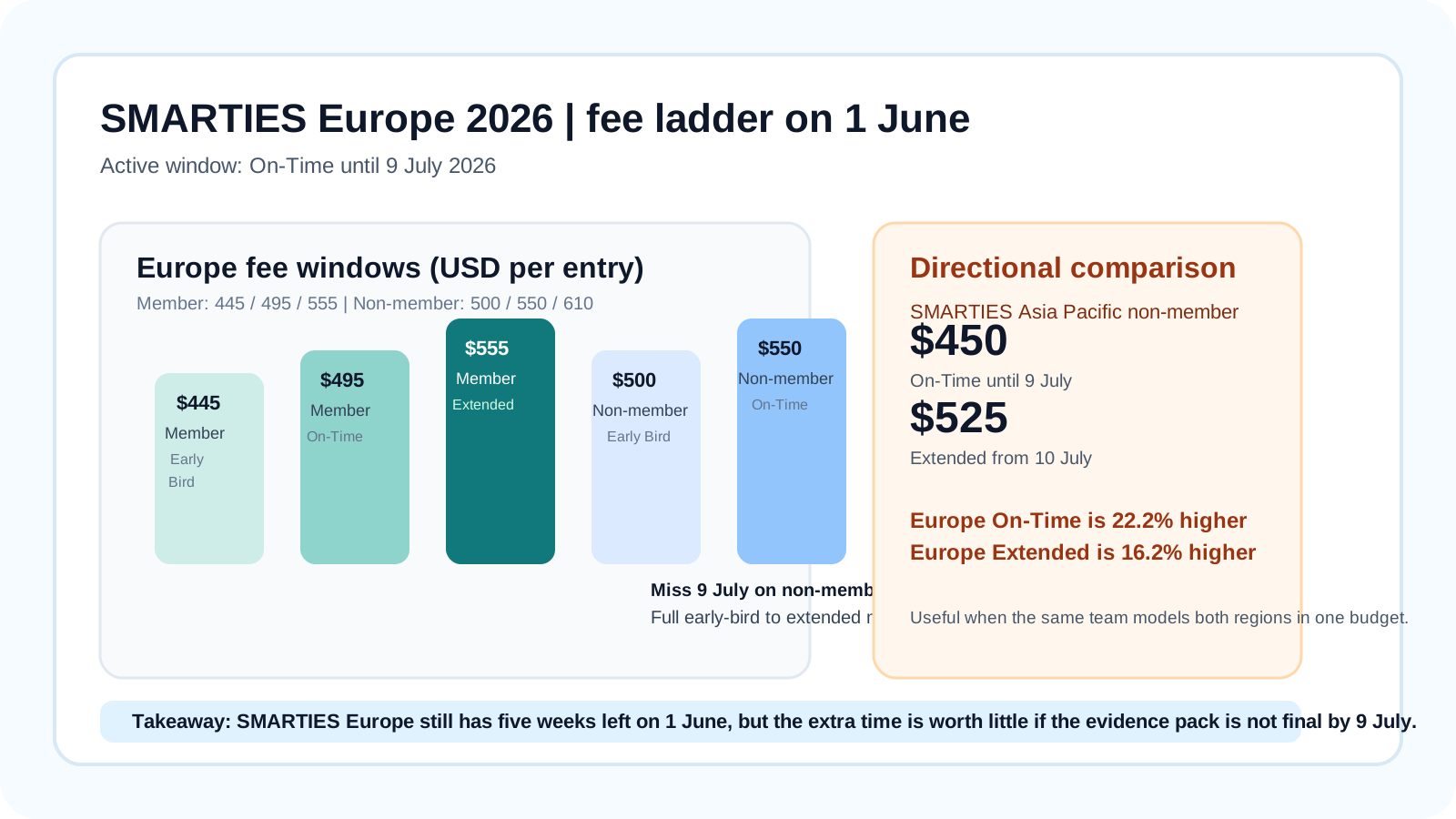
The immediate jump now is from 550 USD to 610 USD on the non-member path, which is a 10.9% increase if you miss 9 July. On the member path, the move from 495 USD to 555 USD is a 12.1% increase. Relative to Early Bird, the full move from 500 USD to 610 USD on the non-member path is 22.0%. Those percentages are not catastrophic per single entry, but they compound quickly once a team starts carrying multiple category variants into the same fee window.
The cleaner comparison inside the same awards family is SMARTIES Asia Pacific. Asia Pacific uses the same 9 July On-Time date but lists 450 USD for non-members and 525 USD for Extended. That means Europe's non-member On-Time price is 22.2% higher than APAC's, while Europe's Extended price is 16.2% higher. If a cross-region team casually assumes all SMARTIES regions cost the same, its budget model is already wrong.
How SMARTIES Europe organizes categories in 2026
SMARTIES Europe is not only an effectiveness deadline post. The categories page makes the structural point clear. The program spans purpose-led work, execution-led work, AI-led work, commerce-led work, and industry-level honors. The top of the page begins with Purpose Driven Marketing, including categories such as Brand Purpose / Activism and Social Impact Marketing. Further down, the same page includes Omnichannel Marketing, Audience Engagement Excellence Using AI, D2C / E-commerce Marketing Excellence, and Industry Awards such as Best in Show.
That spread matters because SMARTIES is designed to reward business impact through different strategic lenses. If your case is strongest as a purpose platform, you should not force it into a performance-first frame just because the result slides look stronger. If it is strongest as a commerce machine, the narrative should lead with conversion design, acquisition logic, and commercial proof rather than broad brand halo.
The categories page also invites entrants to ask for a category recommendation. That is a useful signal from the program itself: category fit is not a cosmetic problem here. It is part of entry performance. Use the Category Recommender before you multiply the same work across too many routes.
A practical screen for the five weeks before 9 July
For SMARTIES Europe, our working rule is to run a four-part screen before a case earns a paid slot.
1. Verify the proof window
SMARTIES Europe requires work that ran between January 2025 and the end of June 2026, and the overview emphasizes verified impact. If the campaign has creative strength but the proof still sits outside that window or cannot be defended, it should not move forward yet.
2. Choose the category family before the category line
Start with the family of the case, not the first interesting label on the page. Purpose work, omnichannel work, AI-led engagement, and commerce-led work should not share the same narrative spine. Build the family logic first, then narrow to the most precise label.
3. Cost the shortlist with discount thresholds in view
Do not model only single-entry pricing. SMARTIES Europe publishes bulk discounts, so the decision is not only whether one more category is worth 550 USD. It is whether that additional entry changes the economics of the whole slate. Use the Budget Calculator to compare the current On-Time band with the Extended band and to test whether the slate should get narrower or broader.
4. Finalize the evidence pack before the invoice clock matters
The fees page explicitly ties pricing to final submissions and invoice timing. If the work, proof, and approvals are still drifting, you are not really inside the cheaper window. Use the entry management workflow to lock owners, proofs, and signoffs before July starts.
Common mistakes teams make with SMARTIES Europe
The first mistake is treating 9 July as a generic submission date instead of a budget boundary. A case that is not materially improving in June should not keep absorbing time simply because the team wants more optionality.
The second mistake is over-crediting the presence of AI language in the category list. SMARTIES Europe does include AI-specific categories, but that does not mean every campaign with a model in the workflow belongs there. The AI route still needs a case built around measurable audience or business impact.
The third mistake is bringing weak result proof into a program that explicitly centers verified impact. The broader awards budgeting guide and the 6-step award submission workflow both matter here because SMARTIES punishes operational looseness more than many teams expect.
Where Awardy fits in a SMARTIES Europe workflow
SMARTIES Europe is a good example of why awards operations should be run as a system. You need verified dates, cost visibility, category discipline, and a structured review path before the deadline pressure peaks. Start with the Awards Calendar to track the 9 July and 14 September milestones, use the Awards Directory to keep the program context close at hand, and move shortlisted cases into a controlled workflow once the paid slate is real.
If your team wants that operating layer in place before July, join the waitlist or request an intelligence report.